Where information gets lost between sales, the warehouse, and finance
A buyer manages a requisition in a spreadsheet, creates the purchase order in ERP, and keeps the supplier’s proposal in email. When the invoice differs from the order or receipt, resolving the discrepancy moves between purchasing, the warehouse, and accounting. Once the process is connected, all documents, decisions, and variances are visible in one case, while approved data returns to the correct system.
A regional manager sees a decline in sales only in an aggregated report. It is unclear whether the cause is product availability, weaker distribution, a promotion, price, returns, or the difference between sales into the channel and sales to the end customer. After the change, a shared data model combines Sell-In, Sell-Out, inventory, products, stores, and promotions. The report presents the variance together with the context required for action.
A customer service employee receives a complaint from a form, store, or e-commerce channel, but the earlier customer interaction is stored in another tool. After implementation, the case has one history, status, owner, and deadline. An exception goes to the responsible role, while management sees case types and where the service process stops.
HR in a distributed retail network collects employee documents from multiple locations, while a change of position or store triggers another series of messages and attachments. Electronic personnel files, requests, and signatures operate in a controlled process connected to the HR system. The document reaches the correct record without files being moved manually.
From an order to after-sales service
We start with a business event: a customer order, store requisition, invoice, price change, complaint, or metric variance. We determine which data originates in e-commerce, ERP, WMS, CRM, a point-of-sale system, a data warehouse, or a supplier file, who makes the decision, and where the result should return.
We then connect AI solutions, AMODIT, KSeF Connector for KSeF (Poland’s National e-Invoicing System), DataFlow, the data and BI layer, custom applications, and the systems used by the organization. Integrations transfer identifiers, documents, and statuses through available APIs, files, queues, or database-to-database exchange according to agreed rules. Each system continues to serve its purpose, while the integration manages activities between applications: approvals, exception handling, reminders, reports, and accountability.
This model works for wholesale and distribution, retail networks, e-commerce, and FMCG, cosmetics, apparel, and consumer health companies. Food and beverage manufacturing adds production planning, quality, and production data to this perspective—an area also covered by our solutions for industry and manufacturing.
AI organizes data and routes exceptions
AI reads invoices and other documents, classifies submissions, organizes information from messages, and flags cases that require attention. In sales analysis, it prepares an explanation of a metric change and a recommendation for the next step. In a contract workflow, it reviews the content and inserts proposed revisions.
We configure existing models for the organization’s data, rules, and dictionaries. AI prepares the result, while an authorized employee reviews and approves it. Change history, roles, and sources remain part of the process, making it clear what the next action was based on.
Why AMODIT is a strong choice for retail and wholesale
AMODIT moves a case across headquarters, stores, warehouses, companies, and roles. It connects a form, document, and data from ERP, e-commerce, CRM, an HR system, or the reporting layer. The process preserves deadlines, substitutions, permissions, history, and exception-handling rules. We develop it as sales channels, the organizational structure, and legal requirements change.
In commerce, the platform connects requisitions and orders, invoices, contracts, complaints, correspondence, employee requests, and signatures, among other processes. Astrafox is AMODIT’s developer and implementation team, so one company is responsible for the product, configuration, integrations, and continued development. The AMODIT product website describes the platform’s detailed features, while Astrafox designs the complete process in the client’s environment.
Processes connected with sales and operations
The overview below spans the industry. Detailed situations, process flows, and our experience are available on eight solution pages:
- Invoice and purchase workflow — a document from KSeF or another channel, cost description, invoice coding, approval, and a connection to the order, delivery, or warehouse receipt.
- Purchasing, requisitions, orders, and budgeting — from the needs of a store, headquarters, or plant through supplier proposals and budget control to an order and settlement.
- Sales, orders, and customer service — inquiries, proposals, orders, complaints, and fulfillment status connected with sales systems.
- Contracts and legal — commercial arrangements, document versions, obligations, deadlines, and AI-proposed revisions approved by a person.
- Mailroom, correspondence, and archive — a shared correspondence register for headquarters, companies, and locations, together with control over case routing.
- Requests, business travel, and administration — equipment, access, travel, expenses, and other matters involving employees in a distributed organization.
- HR and electronic personnel files — employee documentation across stores, warehouses, offices, and plants, file completeness, and HR integrations.
- Electronic signatures — signing contracts, employee documents, and acceptance reports without moving files between email, the process, and the signature tool.
One connected path from e-commerce to ERP
An online channel does not end at the shopping cart, and a wholesale process does not end when a document is issued in ERP. An order moves through availability, payment, picking, delivery, invoicing, returns, and after-sales service. We connect these stages so that the order identifier and current status move across e-commerce, the warehouse, finance, CRM, and customer service.
We implement integrations with any ERP. When a standard interface does not cover the required step, we build a connector or custom application. KSeF Connector connects purchase and sales invoices with the financial system in use, while AMODIT manages steps that require a description, approval, documents, or exception handling. The team maintains the solution and its connections under an SLA-based support model.
Analytics and reporting
Retail and wholesale analytics combines sales, inventory, prices, promotions, products, customers, channels, and locations. We build a shared data model for Sell-In and Sell-Out so that the team does not have to reconcile separate spreadsheets from the manufacturer, distributor, and retailer. DataFlow organizes data acquisition, transformations, tests, and lineage, while Power BI, Tableau, or another tool already in use presents the result to the correct recipients.
Reports cover numerical and weighted distribution, revenue performance by channel, product or brand share, the cost of channel cooperation, promotional effectiveness, inventory, returns, margins, and demand forecasting. Forecasting accounts for seasonality, marketing campaigns, the product portfolio, and supply chain conditions. Metric definitions are shared, and users can drill down from a result to the product, store, customer, or transaction that explains it.
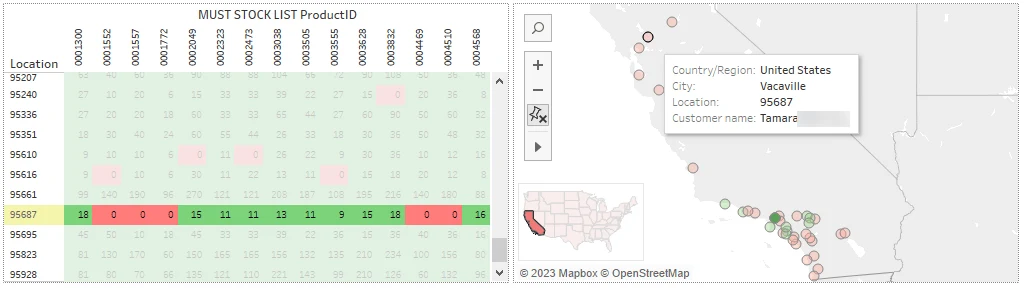
A report is not the end of the process. When a variance is detected, the system creates a task, identifies the person responsible, and records the actions taken. Information about an out-of-stock item, weaker promotion, declining margin, or growing number of complaints then leads to a specific action.
Explore Data & BI solutions → · Explore DataFlow → · See sales and distribution reports → · See trade marketing analytics →
Examples of delivered solutions
Regional sales based on shared data
For a consumer goods company, we organized Sell-In and Sell-Out data from customer portals, files, messages, and databases. A source audit, controlled data pipelines, and shared calculations supply sales, promotion, and product reporting. A change to a source is handled in the data layer instead of separately in each report.
Store and e-commerce complaints in one process
For an organization with a distributed sales network, we built a solution for handling complaints, claims, and feedback from multiple channels. Forms, statuses, substitutions, notifications, appeals, and contact history create one workflow. The customer service team sees the owner and next step, while management sees the structure of submissions and the work process.
Purchasing, receipts, and invoices connected with ERP
For a distribution group, we connected requisitions, purchase orders, receipts, and invoices in one process. Data and statuses are exchanged with ERP, while discrepancies between documents are routed to the correct role. The report shows the stage, accountability, and connection between the document and purchasing decision.
Why Astrafox delivers comprehensive solutions for retail and wholesale
We combine AI, Process Automation, Data & BI, Software & Integrations, Comarch ERP, and Cloud & Infrastructure. We have completed 1,100+ implementations. One team is responsible for the path from an order, document, and data to a report and action, while every project has named account, project, and deputy managers.
The client has one agreement and one point of accountability even when the process spans stores, headquarters, warehouses, e-commerce, and several technologies. We develop the solution as channels, product ranges, companies, and service rules change. We provide SLA-based maintenance and support for the application, integrations, and infrastructure.
Other industries and team perspectives
Commerce connects operations, data, finance, and management decisions. Explore all industry solutions, as well as pages for transportation and logistics, industry and manufacturing, pharmaceuticals and healthcare, financial services and insurance, automotive, and renewable energy.
Team perspectives are covered by the Finance & Controlling, IT, and Management solution pages.
Frequently asked questions
Which integration process should come first?
We start with the entire process: the event, document, data, roles, and exceptions. We then integrate AMODIT and the appropriate Astrafox solutions with the e-commerce, ERP, WMS, CRM, point-of-sale, KSeF, and BI systems already in use. Each system retains its role, while data and statuses move between them without manual retyping.
Do we need to replace the existing ERP, e-commerce, or warehouse system?
No. If an existing system performs its role well, we integrate it with the process, documents, and reporting. We build a new application or connector for a gap that cannot be addressed through configuration or a standard connection.
Why is AMODIT a strong choice for retail and wholesale?
AMODIT routes documents and cases across headquarters, stores, warehouses, companies, and roles. It connects purchasing, invoices, contracts, complaints, requests, and employee documentation with data from other systems. History, deadlines, substitutions, and permissions remain visible in one process.
How do you connect Sell-In and Sell-Out data?
We first align product, customer, channel, and period identifiers, as well as correction rules. DataFlow or another selected data layer then automates data acquisition, standardization, testing, and model loading. The report uses shared definitions and allows users to move from a result to the source data.
How does AI support sales and customer service?
AI organizes information from documents and messages, classifies submissions, flags variances, and prepares an explanation and recommended action. An authorized employee reviews the result, while the system records the decision, status, and subsequent case history.
Where should a project at a retail network or distribution company begin?
Start with one process that regularly requires data from several sources to be combined or accountability to be established manually. For the first discussion, the current process, a list of systems, and an example order, document, report, or complaint where work most often stops are enough.