Where information stops in transportation and freight forwarding
A dispatcher checks a shipment’s status in the TMS, a warehouse employee checks the WMS, and accounting waits for the document in the ERP system. When data does not flow between systems, the client receives an answer only after several phone calls. After integration, the operation’s status and the person responsible are visible in one place.
An accountant receives an invoice for fuel, a ferry, a car wash, or a carrier service, but the shipment and vehicle numbers are stored in another system. After implementation, a document from KSeF (Poland’s National e-Invoicing System) or one read by AI enters the correct workflow, and shipment data is available during invoice coding and approval. A person checks the extracted data before the document moves forward.
An operations manager sees a delay on a dashboard, but the alert does not identify who is responsible for the next action. We connect the report to the process: exceeding an agreed threshold creates a task, routes the exception to the right person, and records the response history.
A branch employee sends a contract, order, or correspondence by email and tracks the deadline manually. After the change, the document has a status, history, permissions, and automatic reminders, while a substitute keeps the process moving.
From a transportation event to a decision, without replacing systems
We do not start by replacing the entire environment. We map the path from a business event to a decision: what data is generated in transportation, freight forwarding, warehousing, or travel services, who approves it, and where the outcome should be returned. We then connect the right elements: AMODIT, KSeF Connector, AI solutions, the data and BI layer, custom applications, cloud services, and the ERP, WMS, TMS, CRM, and carrier systems already used by the company.
Integrations transfer identifiers, documents, and statuses through available APIs, files, queues, or database-to-database exchange according to agreed rules. This keeps the process continuous without retyping the same information across applications. ERP and WMS remain important parts of the environment, but the solution covers the entire workflow—including documents, exceptions, reporting, and accountability outside those systems.
AI supports exception handling
AI reads invoices and other documents, organizes information, and flags cases that require attention. In data analysis, it helps explain a change in a metric and prepares a recommendation for the next step. In contract workflows, it reviews the content and inserts proposed revisions. An authorized employee reviews the result and approves the next action.
We configure existing models for the organization’s process and data. Business rules, change history, roles, and permissions remain part of the solution, so the team knows where the information came from and who made the decision.
Why AMODIT is a strong choice for transportation and logistics
AMODIT routes a case through branches, roles, and stages, connecting a document with data from other systems. The process develops as the organization changes: a new company, cost type, approval path, integration, or exception-handling rule can be added. AMODIT’s developer and implementation team are both part of Astrafox, so one company remains accountable for the product, configuration, and integrations.
The platform handles invoices, orders, contracts, correspondence, and employee cases, among other processes. It also covers warehouse documents and transportation orders. The AMODIT page describes the product’s detailed capabilities, while Astrafox designs and launches the complete process in the client’s environment.
Processes connected to operations
This page presents a cross-functional view. Each process, common situations, and the scope of integrations are covered in detail on the solution pages:
- Invoice and purchase workflow — documents from KSeF and other channels, cost description, invoice coding, approval, and links to an order, receipt, shipment, or vehicle.
- Purchasing, requisitions, orders, and budgeting — from an operational need and supplier offers through an order, budget utilization, and settlement.
- Contracts and legal — negotiations, approvals, deadlines, obligations, and AI-proposed revisions approved by a person.
- Mailroom, correspondence, and archive — a shared register of paper, courier, and electronic mail, with control over case handoffs.
- Requests, business travel, and administration — leave, business trips, expenses, equipment, and other matters for branch employees.
- HR and electronic personnel files — documentation for employees, drivers, and distributed personnel, file completeness, access, and HR integrations.
- Electronic signatures — signing documents without manually transferring files between the process, email, and the signature tool.
- Sales, orders, and customer service — handling inquiries, proposals, orders, complaints, and fulfillment information.
Analytics and reporting
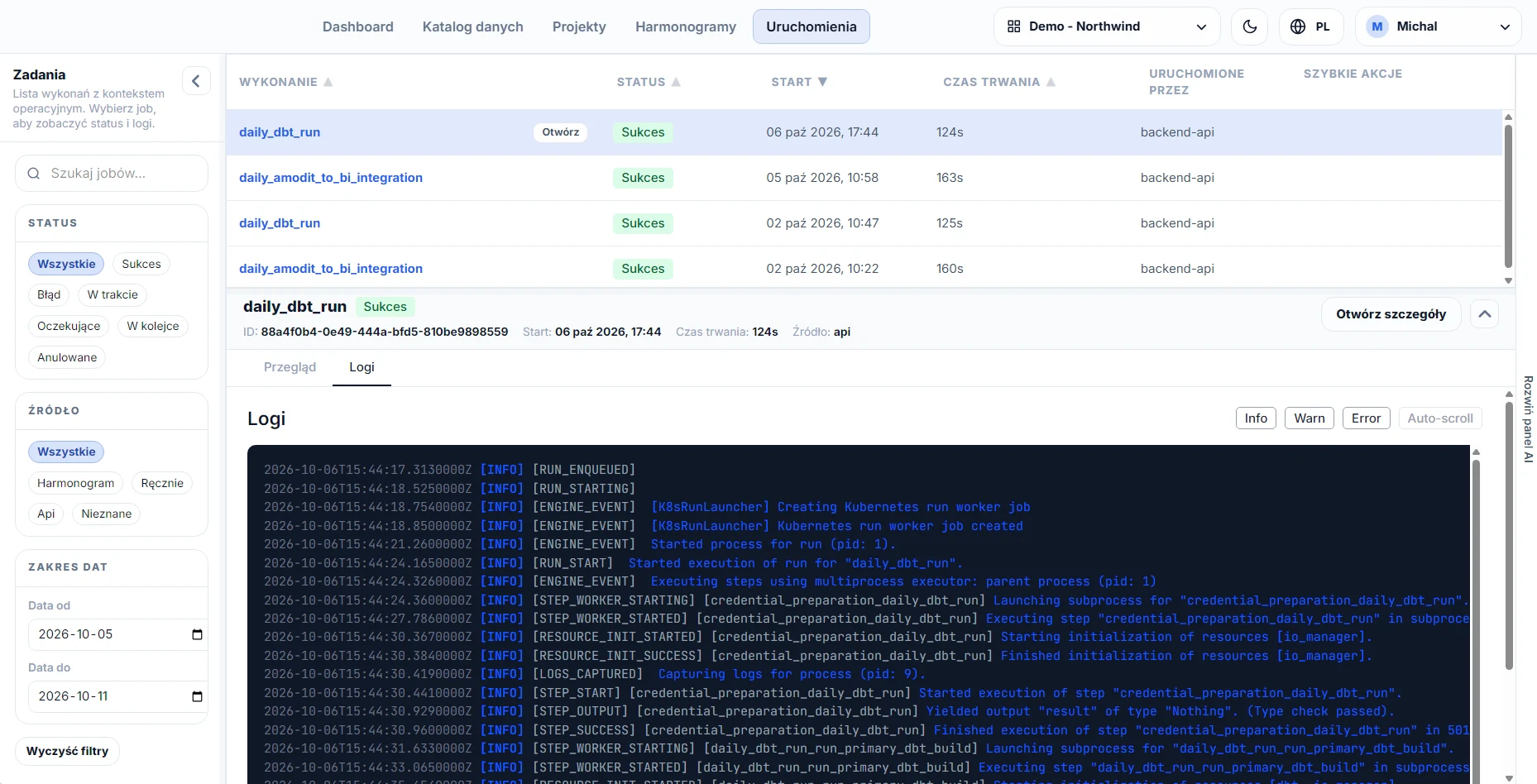
Analytics combines data on orders, routes, shipments, deliveries, inventory, costs, complaints, and deadlines. Instead of more disconnected spreadsheets, the organization gains a shared model of concepts and metrics. A report shows the result and the data that explains it, while an alert routes an exception to a process in AMODIT.
In completed projects, we have developed a map-based freight calculator for Europe, dashboards that support shipment sorting, and recurring reports on first- and second-attempt delivery effectiveness for a high-volume sender. We also develop shipment complaint reports, transportation cost models, and solutions that monitor statuses in external carrier services.
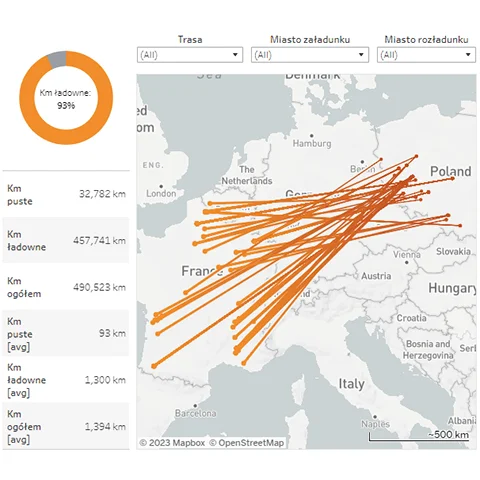
Explore Data & BI solutions → · See reports and dashboards →
Examples of completed solutions
An invoice connected to a shipment and vehicle
For a transportation company, we connected the handling of domestic and international invoices with data from its TMS and financial and accounting system. A document from KSeF or one recognized by AI receives shipment and vehicle context and enters the correct workflow, while the user checks the data before approval.
A transportation order with document control
The process manages an order and suborders, checks document completeness, and prevents the case from closing when required attachments are missing. The driver receives browser access, while the operations team sees a report of missing items and the accountability status.
ERP connected to warehouse transportation
For an organization managing a warehouse, we built an integration between ERP and the equipment performing transportation tasks. The order is sent to the equipment, and the completion status returns to the system without separate handling of both environments.
Why Astrafox provides comprehensive solutions for transportation and logistics
Since 1999, we have combined AI, process automation, data and BI, software, integrations, ERP, and cloud services. We have completed 1,100+ implementations. One team is responsible for the flow between documents, applications, and reports, and every project has named account, project, and deputy managers.
We build the solution around the systems already in use and take responsibility for the application, integrations, and infrastructure. The client has one point of accountability even when the process spans several technologies. We adjust the scope without multilayered procedures when operations, regulations, or the company’s structure require a new path.
Other industries and team perspectives
The logistics process connects operations with decisions made by finance, IT, and management. Explore all industry solutions, as well as pages for industry and manufacturing, retail, wholesale, and consumer goods, pharmaceuticals and healthcare, financial services and insurance, automotive, and renewable energy.
The Finance & Controlling, IT, and Management solution pages provide team-specific perspectives.
Frequently asked questions
Which integration should be launched first?
We first map the event, document, data, roles, and exceptions across the entire process. We then integrate AMODIT and the appropriate Astrafox solutions with the ERP, WMS, TMS, CRM, KSeF, and carrier platforms already in use. Each system retains its role, while data and statuses move between them without manual retyping.
Do we need to replace our current ERP, WMS, or TMS?
No. We start at the points where information or accountability currently gets lost. If an existing system performs its role well, we integrate it with the process, documents, and reporting. We build a new application only for a gap that cannot be addressed through configuration or integration.
How does AMODIT support transportation and logistics companies?
AMODIT routes documents and cases through the correct roles, stages, and branches. It connects invoices, orders, contracts, correspondence, business trips, and transportation orders with data from operational systems. History, deadlines, substitutes, and permissions remain visible in one process.
How does AI read invoices and transportation documents?
We configure existing models to read and organize documents and route exceptions for review. The user reviews the AI output before invoice coding, approval, or passing data to the next system.
How does a report create a task for an employee?
An agreed alert or metric threshold creates a case, assigns an owner, and preserves the response history. The process does not end at the dashboard: the dashboard identifies the data, and AMODIT manages the action through closure.
Where should a project in a distributed organization begin?
Start with one process that crosses several teams or systems and regularly requires manual checks. For the first discussion, the current workflow, a list of applications, and an example document or status where work most often stops are enough.