One problem owner from alert to resolution
The IT director is responsible for system continuity, integrations, data quality, user access, infrastructure costs, and business change requests. Yet a problem rarely fits within a single layer. A change in a source system stops the overnight report feed. A user request lacks data available in other applications. A cloud alert shows the symptom but not the dependency on an application and database. Individual teams check their own parts, while IT combines the diagnosis.
We connect the process, application, data, integrations, and infrastructure in one accountability model. Every request has an owner and a history, integrations are monitored, and the team receives the context required for a decision. After launch, we provide SLA-based support, so the response model is not established only when an incident occurs.
Situations we organize
- An administrator reviews many alarms before finding the event that requires action. The system groups related events, presents their context, identifies the probable cause, and routes the event to the appropriate person for assessment.
- An interface change stops data exchange without an assigned owner. Monitoring detects and records the error, then starts the established handling path.
- The support team asks a user again for data already stored in other systems. An integration adds the required context and statuses to the case.
- An analyst is concerned about changing a model because the dependent reports are unknown. The data layer shows information lineage, dependencies, and test results before publication.
AI supports IT under team control
AI agents analyze infrastructure events, correlate alerts with metrics, and prepare an explanation for the administrator. In IT processes, they organize ticket content, search approved knowledge, and identify the next step. In data work, they help document the flow and detect inconsistencies before they reach a report.
AI recommends, and a person approves. The administrator assesses the cause and decides on the action, while roles, permissions, and change history show who approved the next step. We use existing models and configure them for the organization’s data, rules, and systems. We do not train LLM or OCR models.
Explore AI solutions for business →
Explore Cloud Command Center →
IT processes with a complete execution history
AMODIT handles tickets, access requests, permission provisioning and removal, equipment issuance, license records, and incidents. When an employee joins, changes roles, or leaves the company, tasks reach IT at the right time. Every step has a deadline, assignee, substitute, and confirmation, while authorized users see the complete history.
The process does not end with a form. Employee data, the organizational structure, and access groups are retrieved from source systems. Completion confirmation returns to the case, while a report shows open tasks, deadlines, and team workload. As a result, an audit does not require reconstructing decisions from private inboxes and messaging apps.
Explore process automation in AMODIT →
Explore requests, business travel, and administration →
Integrations designed together with maintenance
We connect business applications, ERP and HR systems, CRM, data warehouses, identity directories, email, reporting platforms, and external services. Integrations exchange master data, documents, tasks, statuses, dictionaries, and feedback. When a standard interface does not support a required step, we build a connector or application that complements the existing environment.
Technical integration layer
We select the exchange method according to system capabilities: REST APIs, SOAP, SFTP, queues, controlled SQL views or staging tables, and files. We also support SSO sign-in and synchronization of groups and organizational structures with identity directories. We document the direction of exchange, error handling, retries, and accountability so the integration is ready not only for launch but also for subsequent maintenance.
Explore software and integrations →
Analytics and reporting for IT
We preserve the established, valuable scope of IT reporting: monitoring system health and analyzing logs, help desk tickets, and infrastructure usage. A report combines information from service tools, cloud platforms, applications, and databases, so managers see the current state and trend instead of manually assembling a picture from several consoles.
Reporting covers areas including:
- the number of open and resolved tickets, their priorities, deadlines, and team workload,
- service quality against established targets and case categories,
- cloud resource costs and utilization,
- storage space and environment capacity utilization,
- application, database, and integration performance,
- alerts when agreed thresholds are exceeded and response history.
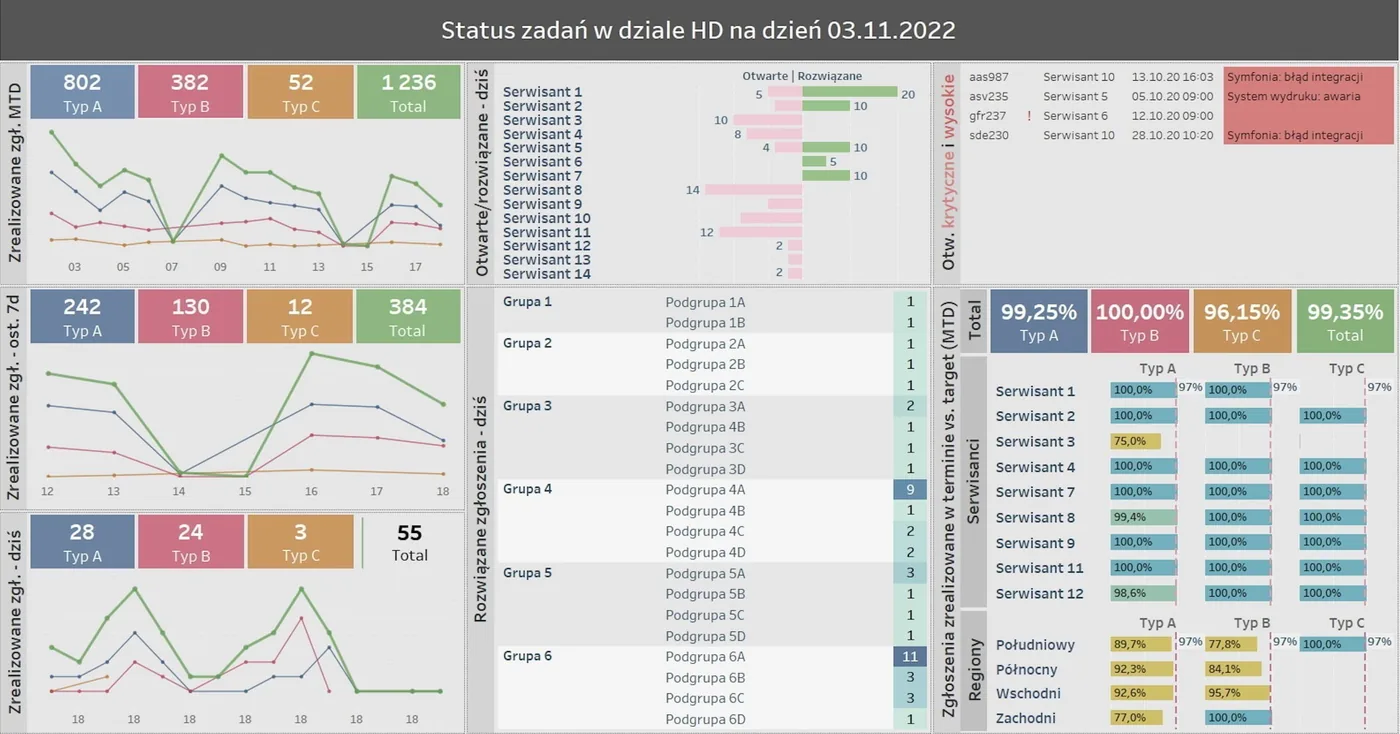
We build the data layer and reports in Power BI, Tableau, Qlik, and other technologies used in the organization. DataFlow automates data preparation, runs controls, and shows data lineage. A report becomes part of the action: a detected variance initiates a task, explanation, or approval in the process instead of ending with a red indicator.
BI maintenance, support, and development
Cloud, infrastructure, and SLA in one model
We audit, build, migrate, and maintain Azure, Google Cloud, and AWS environments. We organize accounts, subscriptions, networks, policies, access, backups, and disaster recovery. 24/7 monitoring covers infrastructure events, and the team responds according to established rules. Cloud Command Center uses AI agents to analyze events and provides the administrator with explained context.
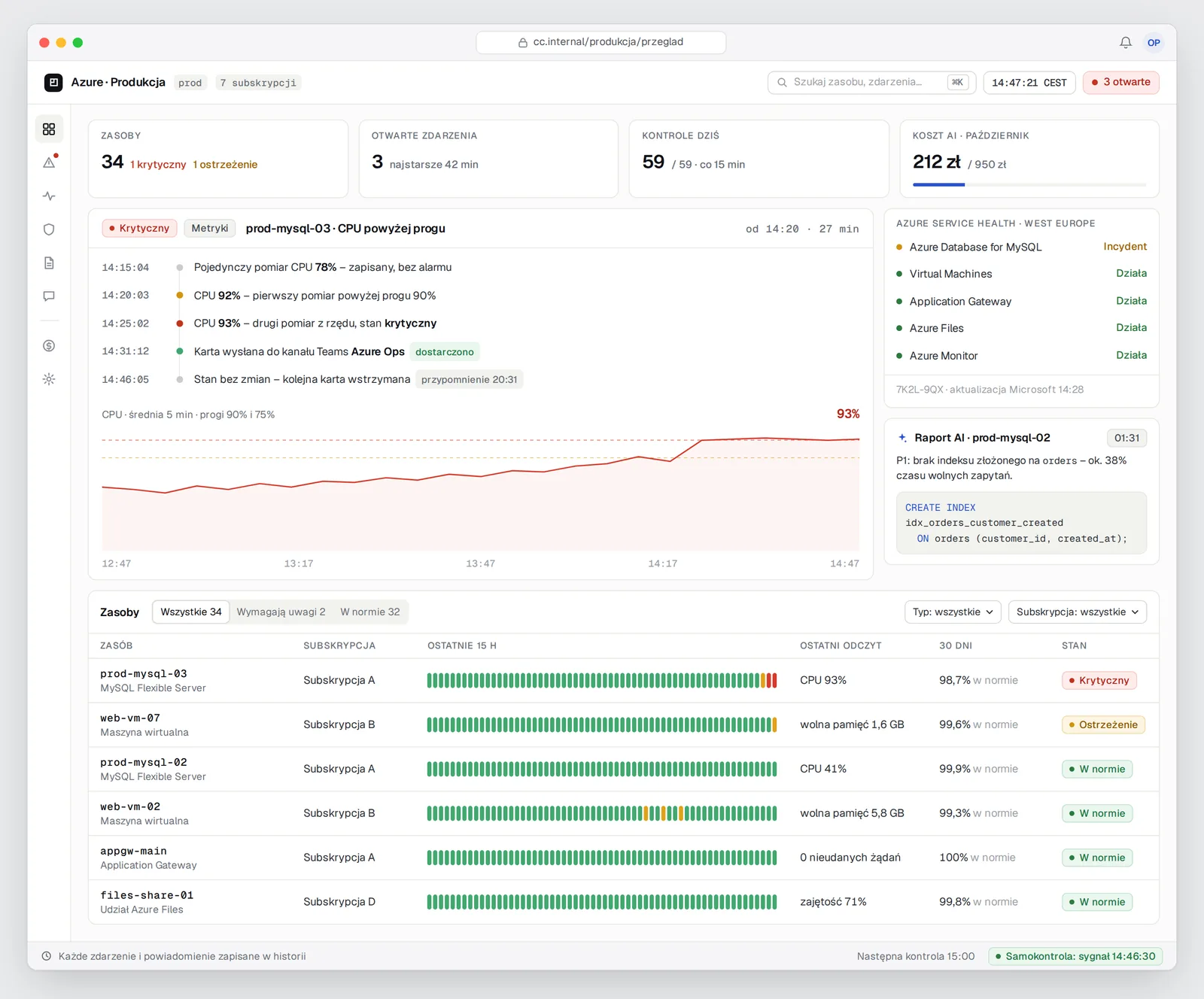
SLA-based support covers AI solutions, AMODIT, BI and data, software, integrations, and infrastructure. The agreement defines ticket categories, response and resolution times, contact channels, service hours, and accountability. IT does not have to arrange separate support for the application, connection, and environment when one team is accountable for all of them.
Explore cloud and infrastructure →
Explore SLA-based system support →
Examples of completed solutions
Service monitoring on a shared operations screen
For a large organization, we launched an analytics environment that monitors service status, trends, and alarms. Dashboards presented information on a wall of monitors, allowed users to move from a signal to its details, and supported the team responsible for service availability.
Maintenance of a data and reporting platform
In an active reporting environment, we took over monitoring, updates, backups, recovery, and access management. The same team developed the reports and data layer, so incident handling accounted for dependencies among the platform, flows, and report content.
A business system with its infrastructure
For a system handling processes and documents, we provided hosting, administration, backups, monitoring, updates, user support, and an SLA. The reporting layer showed case statuses and deadlines, while the infrastructure scaled during periods of higher demand.
Explore Astrafox case studies →
Why AMODIT for IT?
AMODIT organizes accountability in processes that span users, managers, HR, administration, and IT. Forms, roles, deadlines, substitutes, approvals, and execution history remain in one workflow. Integrations retrieve data from source systems and return completion confirmation, so the process does not create another isolated register.
On the Astrafox website, we present AMODIT implementation across the entire company environment: process analysis, integrations, data, cloud, and maintenance. The AMODIT page contains a complete description of product features.
Explore AMODIT and our implementation model →
Why Astrafox for IT?
One team combines AI, Process Automation, Data & BI, software, integrations, ERP, and cloud capabilities. We have operated since 1999 and completed 1,100+ implementations. Every project has a named account manager, project manager, and deputy, while one contract and one point of accountability cover the agreed solution layers.
This approach works when an incident spans an application, integration, data, and infrastructure, and when a standard product must be connected to a nonstandard environment. After launch, we develop the solution and take over SLA-based support for the application, its connections, and infrastructure.
See why companies choose Astrafox →
IT solutions across industries
Explore all industry solutions and examples for transportation and logistics, manufacturing, and automotive. They present the integrations, data sources, and operational requirements that IT teams handle in different environments.
Frequently asked questions
How can a company organize integrations between systems?
We start with a map of systems, data, exchange directions, and business owners. We then define error handling, monitoring, retries, and maintenance accountability. We build or organize connections without replacing systems that still fulfill their role.
Can AI respond to IT incidents autonomously?
AI analyzes events, combines context, and recommends the next step. An administrator approves the action, while the system records the decision history. The level of automation follows the organization’s risks, permissions, and procedures.
How can failures in integrations and data flows be monitored?
We define the expected flow, thresholds, alert owner, and retry method. Monitoring detects missing data, an interface error, or an unusual execution time and routes the event to the appropriate team with technical context.
Do you take over maintenance of an active solution?
Yes. We begin by reviewing the architecture, documentation, access, outstanding tickets, and accountability. We then establish a transition plan, service rules, and SLA parameters for the application, integrations, data, or infrastructure.
Do the solutions run in the cloud and on company infrastructure?
Yes. We design solutions in the cloud, on the organization’s servers, or in a hybrid model. Architecture selection accounts for availability, security, integration, data-location, and maintenance requirements.
Why is Astrafox accountable for more than one solution layer?
We combine expertise in processes, AI, Data & BI, software, integrations, and cloud. The same team understands dependencies among the layers and handles a ticket through resolution without splitting the diagnosis among the application, data, connections, and infrastructure.