KSeF Connector integration
- Challenge
- An ERP or accounting system needs a stable connection to KSeF (Poland's National e-Invoicing System).
- After implementation
- One component handles communication, validation, statuses, and confirmations.
We build custom applications, including AI-powered solutions, and connect systems that need to work together in large organizations: ERP, AMODIT, CRM, data warehouses, and line-of-business applications.
Custom code, AMODIT, or an ERP feature? →Developers, analysts, testers, and architects lead the project from understanding the requirements through launch, maintenance, and further development. We deliver the entire project or complement the client's team.
When an application runs in the cloud, our infrastructure team designs and maintains its environment. See Cloud & Infrastructure →
Software house: team and delivery approachWe know architecture, software engineering, performance, security, and complex project delivery. We specialize in the .NET and Microsoft SQL Server ecosystem, Python, and modern front ends built with Vue.js, Angular, and React.
Our team uses AI in its daily work: for requirements analysis, code, testing, and documentation. Every change undergoes developer review, testing, and security analysis. If a client does not want AI to work with its code or data, we deliver the project without AI.
A separate page explains our delivery stages, engagement models, technologies, security practices, and how we combine software, data, cloud, and process automation expertise.
Each situation shows what consumes time today and what the same work looks like after the change.
An employee reads a document even though an application could prepare the data for the decision.
The application prepares data from the document, and the employee reviews it and makes the decision.
AI-powered application
An order reaches the core system only after someone manually retypes it from a portal.
The order moves from the portal to the core system automatically, without retyping.
Portal-to-ERP integration
A customer asks for a status update, and a representative checks three systems one by one.
The representative sees the case status from all three systems in one view and answers the customer without checking each system separately.
Unified case view
A change to one field in the source system stops the overnight data exchange.
Monitoring detects the error, notifies the responsible person, and retries the exchange after the cause has been removed.
Resilient, monitored integrations
The team knows the workaround for a legacy application but is afraid to change its code.
An application modernized in stages has tests and documentation, reducing the risk of each subsequent change.
Application modernization
A standard system handles the usual cases, but an exceptional process still lives in a spreadsheet.
The exceptional process runs in an extension connected to the system, not in a separate spreadsheet.
Extension beyond the standard system
Our AI agents for requests for proposals (RFPs), sales proposals, and contracts are software products we designed and built using existing language models. We apply the same expertise in client projects where AI needs to read, compare, or prepare output for a person to decide.
One example is Cloud Command Center: an application in which agents monitor infrastructure, analyze slow MySQL queries, and send explained events to the team in Microsoft Teams.
Anyone can use AI today, but not everyone can lead a serious business project. We know architecture, software engineering, performance, security, and complex project delivery. That is why AI in our solutions is part of a stable, secure system with a team responsible for its development.
See our AI solutions →Transaction systems, customer portals, intranets, and e-commerce services designed around the organization's processes, users, and scale.
Internal systems, modules for existing platforms, and data analysis tools connected to ERP and other B2B solutions.
Desktop solutions and internal tools for processes where a browser application is not the best choice.
Interfaces, integration services, and migrations that connect existing applications, preserve historical data, and make it available in the right system.
For Comarch ERP XL, we create additional modules and integrations and implement automated processes.
Monitoring, issue handling, user support, and new features developed as the organization's needs change. Learn about SLA-based support for software and integrations →
Requirements analysis, architecture selection, and an implementation plan, including an assessment of whether to extend the current system or build a new one.
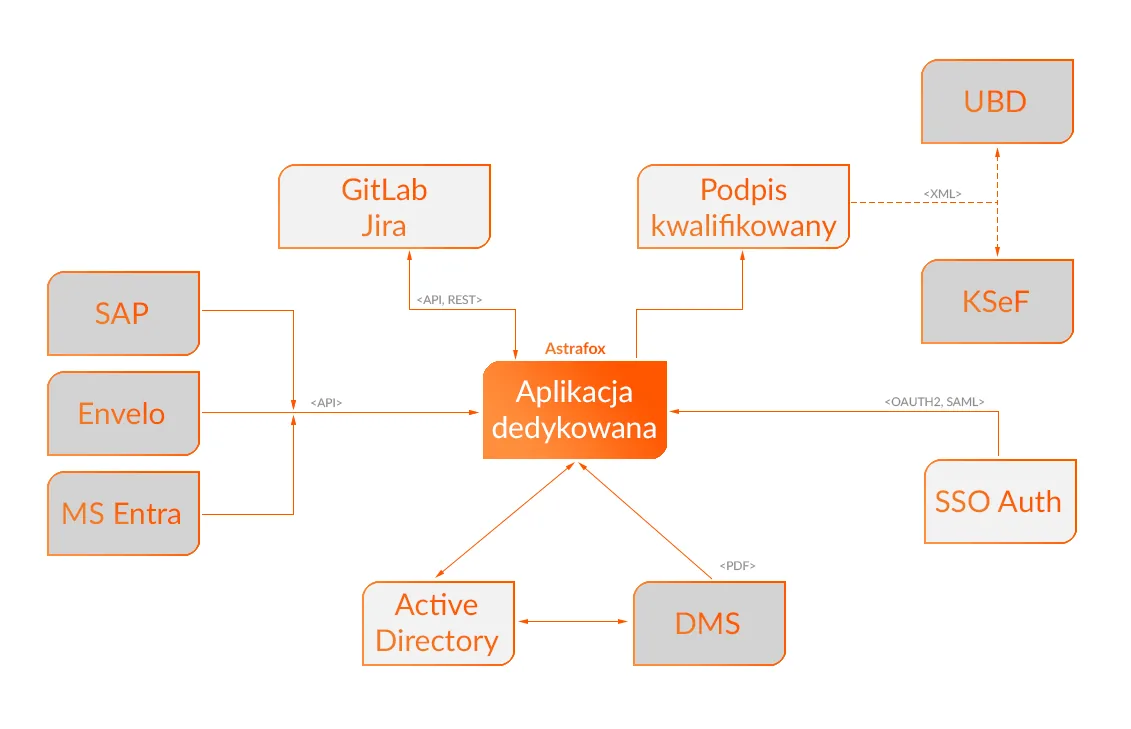
An Astrafox application that prepares data for digital product passports required by EU regulations without replacing the company's systems.
Each example shows the starting point, solution scope, and change in how the work is performed. The descriptions do not name the clients.
Scale: our systems handle millions of documents per year and hundreds of thousands of users.
We do not start by writing code. We have our own process platform, implement ERP, and build software, so we compare configuring an off-the-shelf product, the AMODIT platform, and custom code in terms of scope, risk, and maintenance cost.
Approvals, documents, deadlines, and roles. The AMODIT platform is usually the better fit.
Process Automation →We first check what the system provides. We extend it only where necessary.
ERPSpecific logic, interface, or integration that an off-the-shelf product cannot handle.
Describe your project →We first determine whether the need calls for custom code, an integration, configuration of an off-the-shelf product, or a combination of these elements.
Processes, roles, interfaces, devices, and the number and types of users.
The number of systems, available interfaces, exchange directions, and error handling.
Code quality, documentation, data, dependencies, and modernization scope.
Permissions, auditability, environments, performance requirements, and business continuity.
Acceptance scope, monitoring, knowledge transfer, and accountability after launch.
Describe what should work better, who will use it, and which systems the solution needs to connect. We will use that information to select the right delivery approach.
When a process or integration is so specific that an off-the-shelf platform or standard ERP would require too many workarounds. In other cases, we recommend the less expensive solution.
Yes. We build our own AI agents using existing language models and connect them to client systems. In every solution, a person reviews and approves the AI output.
ERP systems from different vendors, AMODIT, CRM systems, data warehouses, and line-of-business applications. The available interfaces determine the method and scope of data exchange.
We maintain and develop the solution or hand it over to the client's team. We define the engagement model before the project starts.
Since 1999, we have combined expertise in software, processes, data, ERP, and cloud. One team designs the application, integrates it with the company's environment, and supports the solution after launch.
Describe what should work better: the application, an integration, or data exchange. We will advise whether the solution calls for code, a platform, or configuration.
Describe your challenge