Completeness checked along the way
A missing document, signature, or metadata item stops the appropriate stage and reaches the person responsible before the issue moves further.
Employee documentation is scattered, HR checks personnel files for completeness manually, and onboarding arrangements are spread across several inboxes. We organize the employee journey from recruitment and hiring through changes and departure. We connect the process to eTeczka (electronic personnel files), signatures, the HR and payroll system, and reports.
See also: employee administration and service: equipment, access, business trips, and requests →
We design the process across existing systems. Data entered by the recruiter and candidate supplies the documents, eTeczka, and HR and payroll system, while HR, the manager, IT, occupational health and safety, administration, and finance see the tasks assigned to their roles.
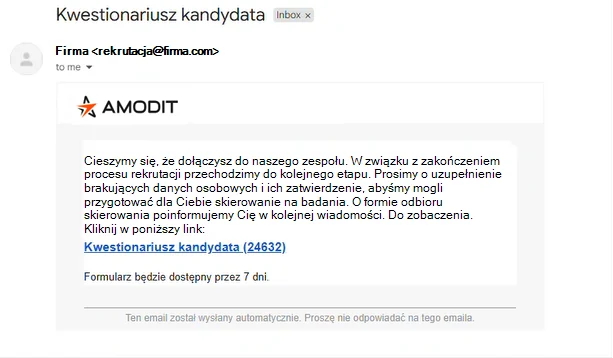
A candidate submission starts the process through a public AMODIT Forms Portal form in the employer's brand, without creating an AMODIT account.
A missing document, signature, or metadata item stops the appropriate stage and reaches the person responsible before the issue moves further.
The candidate, HR, manager, IT, occupational health and safety, and administration work on one case but see only the data they need.
Personnel file sections, categories, numbering, versions, and deadlines are organized, and exports include the documentation with its metadata.
The recruiter enters the candidate's address separately in the referral, contract, and questionnaire.
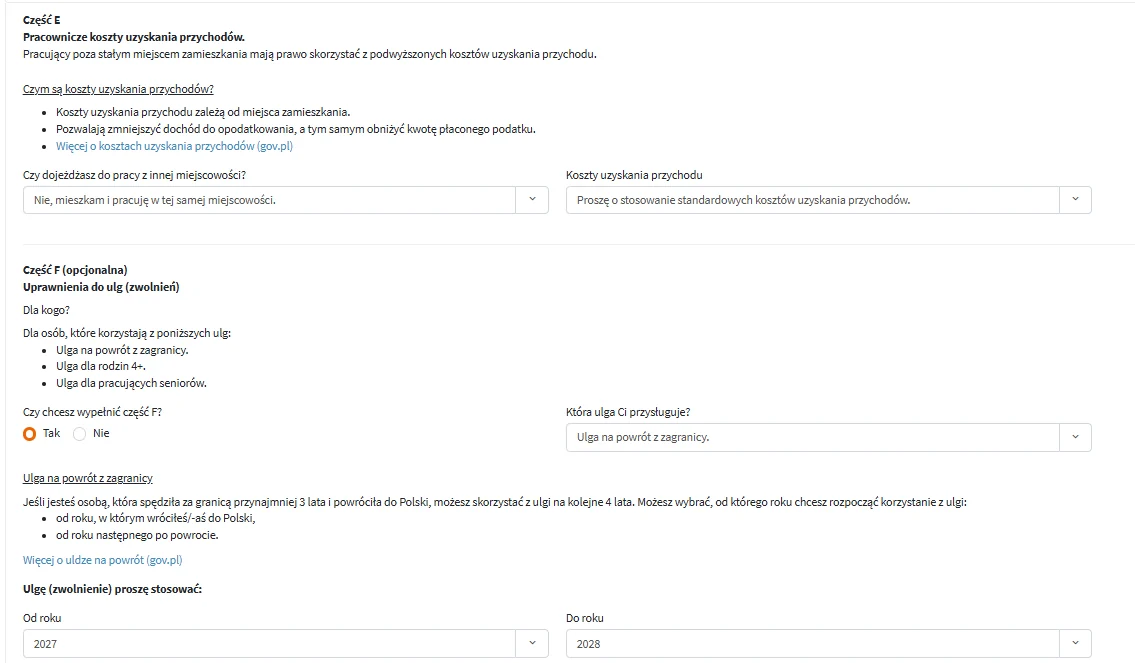
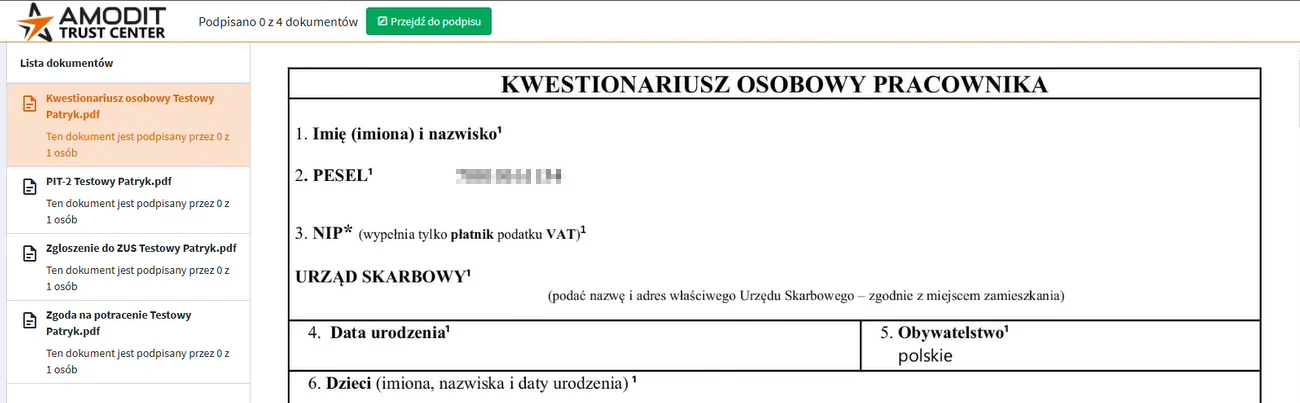
Candidate data entered once goes to the referral, contract, and questionnaire.
Data in multiple documents
A new employee starts work while the laptop and access still await an order.
IT receives a task as soon as the contract is signed, so the laptop and access are ready on the first day.
Cross-department onboarding
HR completes the personnel file after the fact and searches for missing signatures.
Documents enter eTeczka during the process, and a missing signature is visible in the case status.
Employee documentation
The manager asks HR about the hiring status because the full path is not visible.
The manager sees the current hiring stage and who owns the next step.
Process status
The HR specialist checks several screens before preparing data to deregister an employee.
A Comarch ERP Optima feature prepares the deregistration data, and the HR specialist reviews and approves it.
HR and payroll in ERP
A report shows rising absence but does not account for a change in team size.
The report shows absence together with team size, providing the right context for assessing the trend.
Context and measure definitions
AI and OCR prepare data, and a person reviews and approves it. The solution reads a document or identifies information from approved knowledge, but decisions about hiring, employment terms, documentation, and the employee's situation remain with an authorized person. We use existing models and configure them for the client's process—we do not train LLM or OCR models. We process AI data in a controlled environment in EU regions; the models are not trained on client data, ensuring compliance with GDPR and the AI Act.
The employee record connects documents to the right employee. Personnel file sections A–E, categories, metadata, chronological numbering, versioning, and duplicate control organize documentation from receipt through archiving or deletion after the retention period.
Organizational roles and multi-level permissions restrict data visibility. A history of changes, signatures, and access supports control, while retention, disposal, and export are part of a designed process aligned with the organization's policies.
We adapt the process to the organization's structure and rules. What remains consistent is one path for data, documents, and tasks throughout the employment lifecycle.
This universal path shows the stages of the employment lifecycle. We configure roles, documents, deadlines, and exceptions for the company's processes.
The candidate and HR enter data once, and the process supplies the employee record and documents.
The contract, signatures, and tasks reach the right people before the first day of work.
Documents are organized, while completeness, duplicates, and deadlines are controlled.
Amendments, position changes, objectives, and reviews move through assigned roles and approvals.
Offboarding closes tasks and access, and documentation enters the appropriate retention path.
AMODIT runs the case and records the accountability history, while integrations exchange data, documents, and statuses with the HR process environment.
Employment lifecycle, eTeczka, roles, and deadlines.
We use AMODIT and solutions built by Astrafox first. We then connect them to HR and payroll systems and services from other vendors operating in the organization's environment.
On Astrafox's own platform, we build HR processes, eTeczka, the employee portal, signatures, roles, deadlines, notifications, and the decision history.
Explore AMODIT →We read documents and provide approved knowledge at the appropriate process step. The user verifies the output before use.
Explore AI solutions →We build applications for reviews, objectives, development, bonuses, and self-service when the organization's complex rules extend beyond the configuration of an off-the-shelf solution.
Explore Software & Integrations →We connect employment, changes, absences, deadlines, and process statuses in reports with the appropriate level of aggregation and access control.
Explore Data & BI →We run the solution in the Astrafox cloud, the client's cloud, or the client's infrastructure, with access control, backups, monitoring, and defined accountability.
Explore Cloud & Infrastructure →We connect the process to any HR and payroll system. We also implement and develop Comarch ERP Optima and Comarch HR; the ZWUA Documentation Agent remains a vendor feature.
Explore Comarch ERP Optima and Comarch HR →A report should prompt a question about how work is organized, not automatically diagnose a specific employee. Shared definitions, the appropriate level of aggregation, and restricted access give the data the context it needs.
Status and flows over time, with a clear definition of the period, population, and report audience.
A view adapted to the user's role without excessive disclosure of individual-level data.
Signals and comparisons identify areas for analysis. Correlation alone does not prove the cause of a departure.
We have connected HR and eTeczka processes to SAP HR and SAP HCM, TETA, Workday, enova365, Microsoft NAV and Business Central, Comarch ERP Optima and Comarch HR, and Microsoft AX. We also integrate other HR and payroll systems through their available interfaces.
The exchange covers employee records, organizational structure, forms, documents, metadata, working time, requests, signature statuses, and feedback. Active Directory, LDAP, Microsoft Entra, and SSO connect accounts, groups, and permissions.
The scope extends beyond a file repository. It includes roles, documents, signatures, data, integrations, exceptions, and accountability after launch.
Candidate data, the contract, examinations, signatures, and tasks for HR, the manager, IT, occupational health and safety, and administration.
Personnel file sections A–E, categories, metadata, numbering, versions, search, and completeness control.
PIT and PIT-2 tax forms, RMUA statements, payslips, statements, forms, and encrypted distribution.
Simple, advanced, and qualified signatures, seals, bulk signing, and storage of the document in the personnel file.
Amendments, position, terms, subsequent contracts, termination, and settlement of access and equipment.
Objectives, competencies, performance reviews, development conversations, training, appeals, and action plans.
Bonus models, approvals, confidentiality, decision history, and reports for the employee, manager, and HR.
Scanning, quality enhancement, OCR, indexing, migration, export, archiving, disposal, and deletion after the retention period.
Onboarding and offboarding also trigger administrative requests, signatures, purchases of equipment and services, and invoice workflows for benefits, training, or occupational medicine.
This catalog presents the processes, documents, integrations, controls, and reports we connect in an organization's environment. We select the scope for the organization's process, systems, and needs.
Our implementations cover more than 100,000 electronic personnel files. The largest scope includes more than 40,000 eTeczka files in one organization; we have also migrated approximately 3.8 million documents and prepared packages of up to 200,000 documents for signature. Clients in this area include LPP, Adecco, Polpharma, Holcim, Currenda, Grupa Pracuj, and Rossmann.


Standardizing HR processes after acquisitions, integrating different systems, and developing the solution after launch.
View case study →eTeczka, employee documentation, signature digitization, and integrations described in a public case study.
View case study →Centralized tasks, backup coverage, and access to employee documentation described on the AMODIT clients page.
View AMODIT clients →We adapt the project to the company's structure, locations, and roles: from groups formed through acquisitions, through healthcare and pharmaceuticals, to transportation, logistics, and technology organizations.
We run the solution in the Astrafox cloud, the client's cloud, or the client's own infrastructure. The architecture follows the organization's security rules, data location, integrations, and operating model.
We organize roles, documents, personnel file sections, exceptions, permissions, retention, source data, integrations, and test scenarios.
We prepare the import or digitization, environments, user testing, a pilot, guidance, and training for HR, administrators, and IT.
We provide maintenance, updates, error handling, integration monitoring, and process development following organizational or legal changes.
Explore SLA-based support →HR, managers, candidates, IT, occupational health and safety, administration, and process variants.
Forms, templates, eTeczka, signature types, and the required approval workflow.
The HR and payroll system, ERP, AMODIT, email, identity, and reporting.
History scope, data quality, mapping, and the method for secure transfer.
Access to employee data, compliance requirements, and acceptance scenarios.
Selected products, number of users, and accountability after launch.
These resources show roles, the candidate journey, and document completeness controls in a real HR process.
How to connect the recruiter, candidate, HR, occupational health and safety, authorized representative, and manager without re-entering data.
Read the article →How to design account-free access, forms with guidance, online signatures, and a secure candidate journey.
Read the article →How to check data, examinations, the contract, signatures, and storage in eTeczka at successive stages, not only at the end.
Read the article →This page shows how we implement and integrate the solution in the company's environment. A detailed description of HR and electronic personnel documentation features is available on the product website.
HR features in AMODIT →For a large energy group, we have developed and maintained a family of HR systems for years: employee self-service, electronic personnel files, development conversations, and management objectives. In the largest implementations, an HR self-service system handles up to 1 million requests per year and 20,000+ users.
View case study →No. We establish the role of the source system and connect it to the process, eTeczka, signatures, portal, and reporting. We integrate solutions with SAP HR and SAP HCM, TETA, Workday, enova365, NAV and Business Central, Comarch ERP Optima and Comarch HR, and other systems that provide the required interface.
The scope covers employee records, personnel file sections A–E, document categories, metadata, numbering, versions, completeness and duplicate controls, deadlines, permissions, retention, archiving, and document exports with metadata. The project defines the documents and rules appropriate for the organization.
Yes. The scope covers secure transfer of the records, test scanning, quality enhancement, indexing by documentation section, PDF export with XML metadata, import into eTeczka, and reconstruction and return of the paper documentation.
Yes. The process prepares documents, routes them for signature, controls the status, and stores signed files in the appropriate employee record. We support simple, advanced, and qualified signatures, seals, and bulk signing.
Yes. A good starting point is a process with a clear owner, repeatable steps, and a visible problem: data re-entry, missing status, or unhandled exceptions.
Visibility follows the role, organizational unit, process stage, and permissions for the specific data scope. We configure authentication, SSO, groups, change history, and employee, manager, HR, and administrator access in line with the organization's policies.
We establish the purpose of the analysis, audience, aggregation level, measure definitions, and access rules. The report presents signals and context for assessment by an authorized person; it does not automatically diagnose a specific employee.
Yes. We run it in the Astrafox cloud, the client's cloud, or the client's infrastructure. The project defines data location, environments, access, backups, monitoring, integrations, and maintenance accountability. After launch, we provide SLA-based support and development.
We support 100,000 eTeczka files. We connect employee documentation to HR processes, signatures, portals, and HR and payroll systems and provide support for the entire solution after launch.
Describe the process, employee documentation, and HR systems. We will organize the scope of eTeczka, integrations, migration, and accountability.
Describe your challenge