Sources, credentials, and roles
DataFlow lets the team search for a connector, test a connection, and select data sets. Secrets are managed centrally, while workspaces separate integrations, credentials, and roles for departments or companies.
Pipeline definition, SQL models, and tests
Sources, tables, models, tasks, and processes are described together. The logic covers cleaning, joins, aggregations, and calculations in SQL and dbt, along with tests for completeness, uniqueness, relationships, and business rules.
Change, validation, and publication
A change is created outside the live solution. Differences, dependencies, and the publication plan are visible; results can be checked on the data, and an authorized person performs the publication.
Catalog, lineage, and SQL analysis
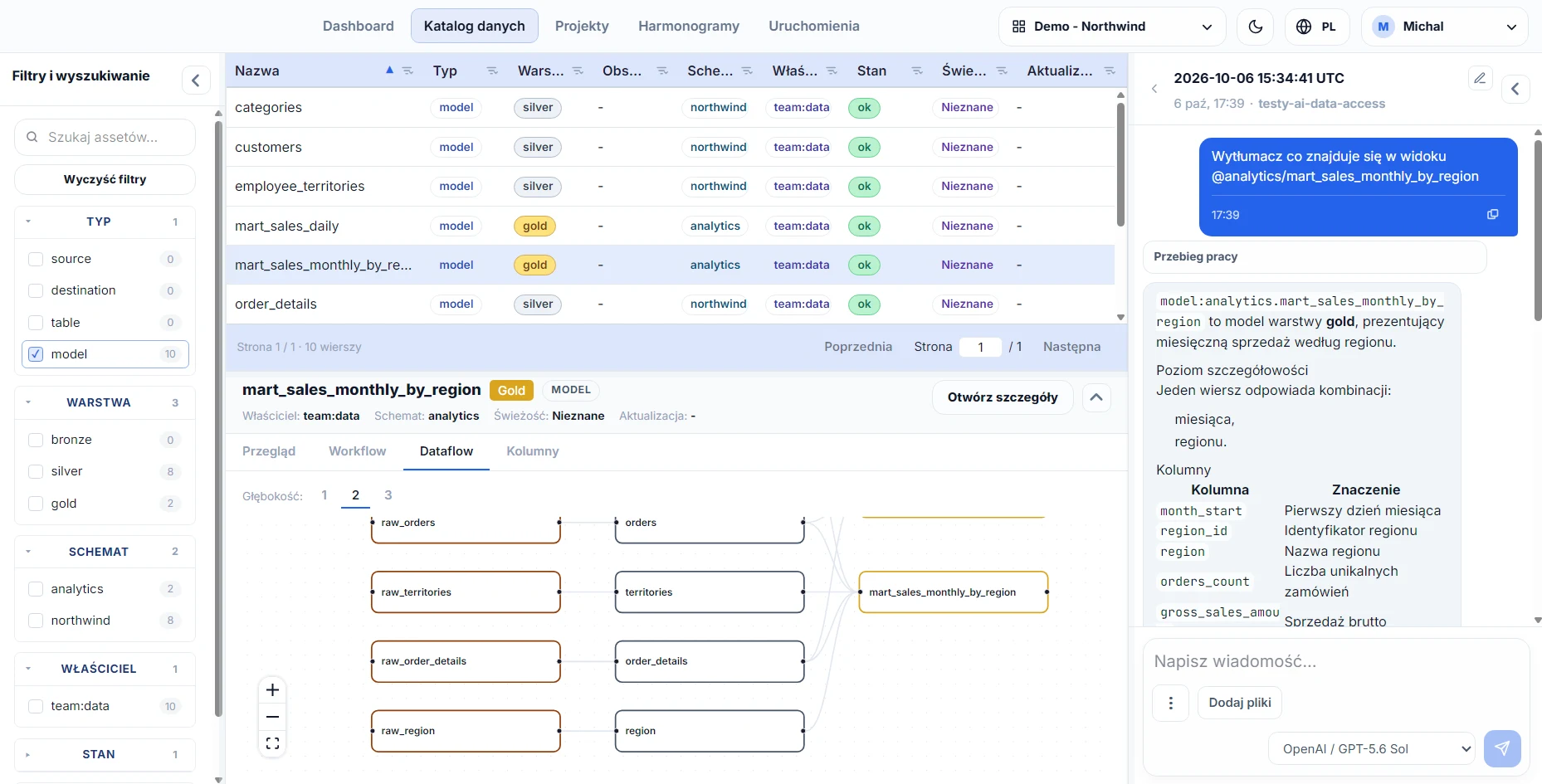
The catalog combines descriptions, owners, freshness, tests, and history. A graph shows model dependencies and column-level lineage, while SQL analysis breaks a query into clear stages.
Schedules, runs, and history
The platform shows consecutive runs, steps, duration, records, and errors. Configuration has a history and version differences, making it possible to determine who changed a calculation method and when.
AI assistant in the data context
The assistant explains models, prepares proposed changes, generates their descriptions, and analyzes errors using the solution's current structure. A proposal follows the same validation and publication path as every other change.
Source systemsMore than 500 ready-made connectors
We connect ERP and accounting systems, CRM and sales systems, help desks, project and marketing tools, Microsoft SQL Server, PostgreSQL, MySQL, Oracle, and MongoDB databases, Excel and CSV files, Google Sheets, SharePoint, FTP, SFTP, and object storage. We connect custom applications through an API, a database, or a custom connector. During the analysis, we verify the specific connection method.
Sales and financeA shared view of CRM, ERP, and project system data
Customer, invoice, and project settlement data is stored in three places, and the monthly report requires manual reconciliation. We connect the sources, reconcile keys, and build a shared model that runs on a schedule. Every item can be traced back to the source system.
MigrationMoving processes from Alteryx or KNIME
Critical workflows run on individual workstations, and knowledge of some of them left with their author. We analyze the logic and dependencies, reconstruct the processes in DataFlow, and compare control results. Runs move to a server, while the logic becomes transparent and version-controlled.
File-based reportingFrom manual exports to a repeatable process
A recurring report is assembled from several manually downloaded files and a spreadsheet with formulas. We move the rules into models, describe them in the catalog, and set a schedule. The application shows the execution path and the cause of an error.
Analytics developmentA safe change to an existing model
The team wants to add a metric or change a source but does not know which reports and models depend on it. The team reviews dependencies, analyzes the SQL, tests the result, and reviews the scope. The change has a described impact, a verified result, and a history.
The differenceLogic is not locked in a proprietary tool format
Compared with spreadsheets and desktop workflows, DataFlow centralizes runs, history, tests, and access. Compared with a self-built Airbyte, dbt, and Dagster stack, it adds a shared interface, catalog, data lineage, roles, and implementation and maintenance by Astrafox.