Exasol: the world’s fastest analytical database
Big Data is usually associated with enormous volumes of data measured in petabytes and many columns. There is also a simpler definition: if data or a report takes more than a minute to arrive, there is probably a high-volume data problem. The missing element in the infrastructure is Exasol—an ultra-fast, fully scalable analytical database for analyzing vast volumes of data in real time.
Exasol is an intelligent, self-managing database based on in-memory technology. It has no limits on the volume of data processed or the number of concurrent users. It handles hundreds of terabytes of data and thousands of concurrent sessions. It runs on local servers or in the cloud.
Exasol supports SQL queries and therefore integrates well with reporting solutions such as Tableau, Qlik, and Power BI. It also works with ETL solutions such as Alteryx, which execute processing directly in the analytical database.
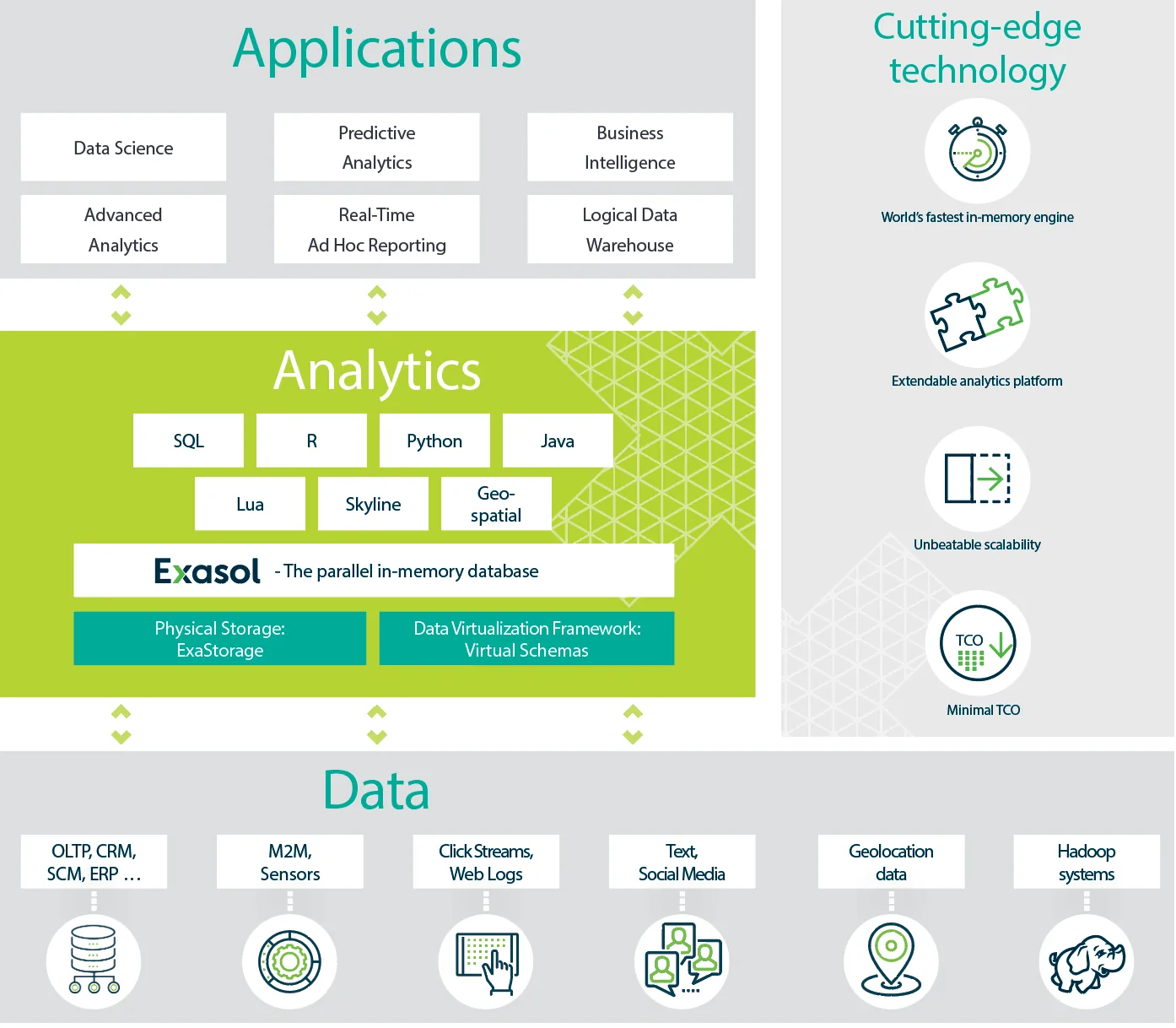
Key Exasol capabilities
Analytics based on in-memory technology
Innovative in-memory algorithms process vast volumes of data in main memory, providing significantly faster access to data.
Massively parallel processing (MPP)
Exasol processes vast volumes of data in parallel. Queries are distributed across all nodes in the cluster using optimized parallel algorithms that process data locally in each node's main memory.
Compression and columnar data storage
Compression and columnar data storage reduce the number of operations and the amount of data that needs to be processed while increasing analytical performance.
Faster access to more data sources
Virtual schemas and a high-performance data integration framework make it possible to connect to and analyze data from more sources than ever before.
Full Hadoop support
Exasol supports all native HDFS file formats, making it faster and easier to create analyses of both structured and unstructured data.
Advanced in-database analytics
Exasol supports R, Python, Java, and Lua, allows other analytical programming languages to be integrated, and uses them for in-database analysis.
High numbers of concurrent users
Thousands of users access and analyze large volumes of data at the same time without affecting database performance.
Extensive integration capabilities
Exasol connects to existing SQL-based BI tools for data analysis, reporting, and integration through ODBC, JDBC, .NET, and a JSON-based API.